
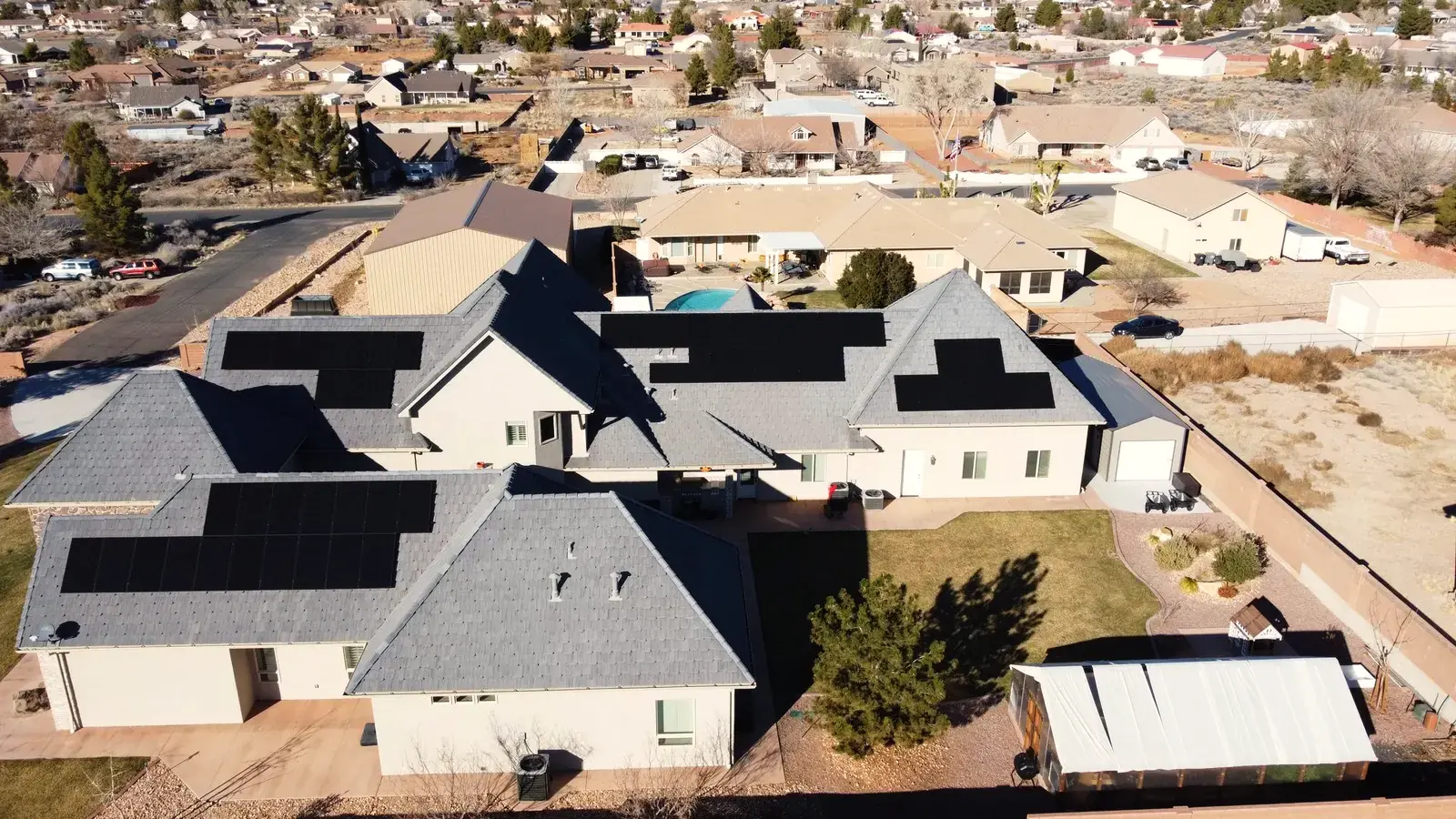
A lot of homes in St. George, Washington and Hurricane already have solar on the roof. If you're buying a house with solar panels, or you just moved into one, the system came with paperwork, accounts and a few deadlines that nobody hands you at closing.
None of it is hard. It just has to get done, and some of it works best before you sign.
The short version:
- Find out who owns the system. Owned, leased and power purchase agreements (PPAs) work very differently when a house sells.
- Get the paperwork. Contracts, permits, warranties, the utility agreement and past production numbers.
- Some warranties need you to act. At least one major manufacturer requires a change of ownership form and a fee within 30 days of the transfer.
- Put the power account and the monitoring in your name. Otherwise you can't see if the system breaks.
- Don't expect a tax credit for it. The federal residential solar credit ended for systems placed in service after 2025.
We're not a law firm or tax advisor. For questions about contracts, liens or taxes on your purchase, check with a real estate attorney or tax professional.
Who owns the solar? Owned, leased or PPA
This is the first question, and it changes everything after it. The Department of Energy lists "what is the ownership structure of the system?" among the questions to ask before you buy (DOE).
- Owned outright. The seller paid cash or already paid off a loan. The panels are part of the house and become yours at closing.
- Owned with a loan still on it. The loan has to be dealt with before or at closing. Depending on the lender, that means paying it off or transferring it. Tesla, for example, says its own solar loans must be paid in full before the transfer can be completed (Tesla).
- Leased or PPA. A company owns the equipment and the seller pays it each month. If you take it over, you take over that contract. Tesla says the buyer picks up where the original customer left off, not a fresh term, and only the seller can start the reassignment (Tesla).
A lease affects your mortgage too. The National Association of Realtors notes that a lease may involve a UCC lien on the property, and that your lender will count the lease payments when deciding how much you can borrow (NAR, May 2026). Tell your lender and title company about the solar early so a lien filing doesn't surprise anyone the week of closing.
If the system is leased, read the agreement before you commit. Look at the monthly payment, how much is left on the term, any yearly increase, and who handles repairs. If the numbers don't work for you, that's a fair thing to negotiate, or a reason to walk away.
Buying a house with solar panels: what to ask before closing
Ask the seller, or their agent, for these:
- The contract. Purchase, loan, lease or PPA paperwork, whichever applies.
- Permit and final inspection. NAR suggests confirming the system was "properly permitted and inspected" (NAR).
- The utility's interconnection agreement. This is the approval from the power company that lets the system run connected to the grid.
- Warranty documents for the panels, the inverter and any battery, plus anything left on the installer's workmanship warranty.
- Production history. A year of monitoring screenshots and power bills tells you what the system actually does. DOE suggests asking how much energy it produces and how old it is (DOE).
- Equipment details. The brand and model of the inverter and panels, and whether there's a battery.
- Who installed it, and whether that company is still in business.
Two more things worth your time: a roof inspection, since removing panels to fix a roof later costs extra, and a look at the system by someone who works on solar. A general home inspector may only note that panels are present.
If the installer is gone, don't panic. Our post on what to do when your solar company went out of business covers who to call and what's still under warranty.
Warranties: some transfer, but not automatically
Equipment warranties come from the manufacturer, not the seller. Many of them can follow the house, but read the fine print.
Enphase's microinverter warranty for products activated on or after October 1, 2023 is a good example. It says a new owner keeps coverage as long as the equipment stays at its original location, the new owner registers it, submits a "Change of Ownership Form" and pays the transfer fee within 30 days of the transfer (Enphase IQ8 limited warranty, US and Canada). Older Enphase products, and other brands, have their own terms. Find the warranty for your exact model and check what it asks of a new owner.
Tesla handles Powerwall transfers through customer support. It asks for a copy of the deed naming you as the new owner and a photo of the sticker on the Gateway and each Powerwall, and it can only process the transfer after the sale closes (Tesla).
The installer's workmanship warranty, which covers roof penetrations and wiring, is a separate promise. Ask whether it transfers and how much time is left on it.
Put the power account in your name
Southern Utah homes get power from Rocky Mountain Power or, in some areas, a city utility, and each has its own solar rules. Call your utility when you set up service, tell them the home has solar, and ask whether the existing agreement carries over or you need to sign a new one.
For Rocky Mountain Power customers, the good news is in the tariffs. Both the older net metering program (Schedule 135) and the transition program (Schedule 136) say service "is transferable to a subsequent Customer at the premises" while a valid interconnection agreement is in effect (Schedule 135, Oct. 2017; Schedule 136, Sept. 2022). So buying the house doesn't by itself move you onto a newer program.
Two catches:
- These programs end. Schedule 136 terminates December 31, 2032 (Schedule 136). Utah Clean Energy says the original net metering customers are grandfathered until January 1, 2036 (Utah Clean Energy).
- Adding panels can change it. Both tariffs say Rocky Mountain Power may end service if the customer makes a "material modification to increase the size" of the system, and you'd apply again under the rules in effect then. Ask before you expand.
Newer systems are on net billing (Schedule 137), where the export credit is updated every year. The current rates took effect March 1, 2026, and Rocky Mountain Power files new ones each year ahead of March 1 (Schedule 137 filing, Jan. 2026).
If you're on St. George city power, the city runs its own net metering program, and it requires new customer generators to complete a net metering agreement with a notarized signature (City of St. George, revised March 2024). Ask the city what it needs from a new owner.
Get the monitoring into your hands
Monitoring is the only easy way to know the system is working. Without it, a failed inverter can sit for months before a power bill gives it away.
Ask the seller to remove the home from their app account before they leave, and to give you the brand and serial number of the inverter or gateway. Then contact the manufacturer or installer to add the system to your own account. Tesla, for instance, has a cash-purchase owner remove the home from their app so the new owner can register the equipment in theirs (Tesla).
You'll also need to connect the equipment to your own Wi-Fi. Our guide on reconnecting solar monitoring to new Wi-Fi walks through Enphase, SolarEdge and Tesla.
What about the tax credit?
The 30% federal credit was for the person who paid for a new system, and it's over for new systems. The IRS says the residential clean energy credit "is not available for any property placed in service after December 31, 2025" (IRS). Buying a home that already has solar doesn't come with a credit for you. If a listing suggests otherwise, ask a tax professional before you count on it.
When to call someone
Call an electrician who works on solar if:
- You can't tell who owns the system or what equipment it has.
- Production looks low compared to past bills or the seller's screenshots.
- The inverter shows an error light, or the app has been offline a while.
- You want the system checked before your purchase window closes.
We look at systems we didn't install all the time, including Enphase, SolarEdge and Tesla. If you're buying a home with solar, or just bought one, book an inspection and we'll check the system and explain what you have in plain English.
Sources
- U.S. Department of Energy, A consumer's guide to buying a house with solar panels, April 2023, accessed November 13, 2026.
- National Association of Realtors, Consumer guide: how solar impacts a real estate transaction, May 6, 2026.
- Tesla, Transferring ownership of your solar system, accessed November 13, 2026.
- Tesla, Transferring ownership (Powerwall), accessed November 13, 2026.
- Enphase, IQ8 microinverter limited warranty, US and Canada, effective for products activated on or after October 1, 2023 (copy hosted by a retailer), accessed November 13, 2026.
- Rocky Mountain Power, Schedule 135 net metering service, compliance filing, Utah Public Service Commission, October 24, 2017.
- Rocky Mountain Power, Schedule 136 transition program for customer generators, Utah Public Service Commission, September 29, 2022.
- Rocky Mountain Power, Schedule 137 net billing service, annual update, Utah Public Service Commission, January 26, 2026, effective March 1, 2026.
- Utah Clean Energy, Connecting solar to the grid and export credit rates, undated, accessed November 13, 2026.
- City of St. George Energy Services, Net metering program, revision effective March 8, 2024.
- IRS, Residential clean energy credit, last reviewed July 4, 2026.