
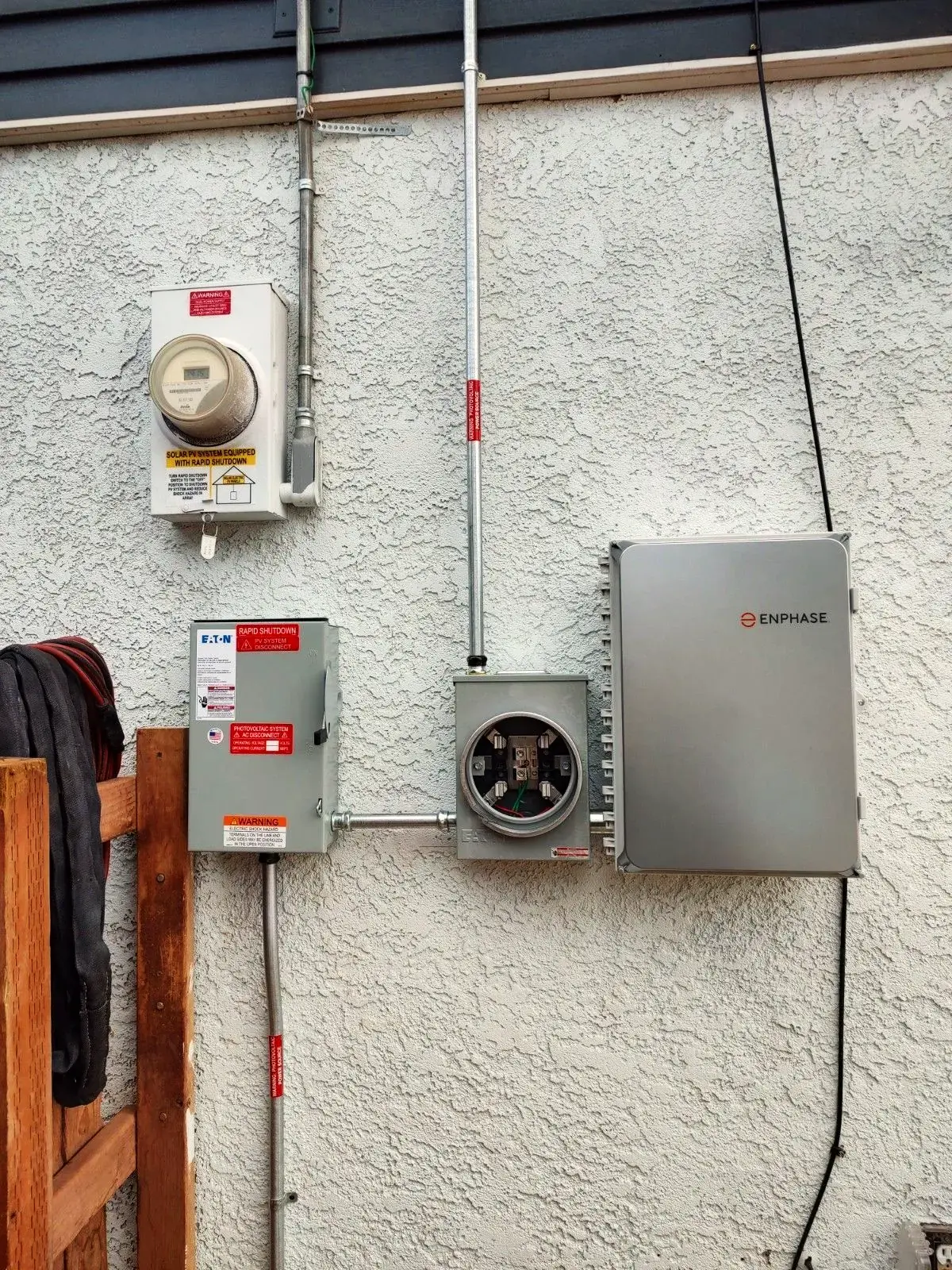
In Washington County, your power company depends on where you live. St. George net metering, Washington City's credits, Hurricane's credits and Rocky Mountain Power's net billing all treat solar in their own way, because St. George, Washington and Hurricane each run their own city power department.
Those rules decide how big a system makes sense, what your extra power is worth, and what paperwork comes first. So before you compare quotes, find out which one you have.
The short version:
- Check the name on your power bill. That's your utility, and its rules apply to your solar.
- St. George keeps extra solar power as kilowatt-hours on your meter, but charges a monthly fee on everything your system produces.
- Washington City credits extra power in dollars each month, caps home systems at 16 kW AC and has a citywide limit on solar.
- Hurricane credits extra power at 4¢ per kWh, lets credits roll until July 1 and then resets them to zero.
- Rocky Mountain Power credits exports at about 4 to 5¢ per kWh, and unused credits expire once a year.
- Every utility wants approval before anything goes on your roof.
The rates below are from each utility's own documents, dated in the sources. Rocky Mountain Power updates its export credit every March 1, and the cities can change theirs, so confirm the current numbers before you sign anything. We're not a law firm, so for questions about a specific agreement, ask the utility or an attorney.
First, find out who your power company is
Don't go by your mailing address or your city name. Go by your power bill. The utility named on it is the one that will approve your system, install the meter and decide what your extra power is worth.
If you're building a new home or buying one, ask the seller or builder for a recent bill. It's a two-minute question that can change the whole solar decision.
St. George net metering: credits stay on the meter
Of the four, St. George Energy Services is the closest to old-style net metering. When your system makes more than your home uses, the city says the "kWh credit will remain on the bi-directional meter," so extra power from a sunny spring can cover power you use in a hot summer (St. George net metering program, revised March 2024).
There are trade-offs:
- A monthly Solar Reliability Charge. The city bills it on every kilowatt-hour your production meter records, whether you used that power or sent it back. The amount is in the program's appendix, so ask for the current figure.
- A December check-up. If you have 5,000 kWh or more of credit in the December billing cycle, the city buys it back at its "Renewable Power Rate Available" and resets the meter to zero. Smaller credits stay on the meter.
- You pay for the meters. The program says the customer covers the cost of the meters and installs the base for the production meter near the main meter.
- Size depends on the circuit. Systems up to 10 kW AC on single-phase power are the simpler review level. Larger systems, and any system with a battery, get a fuller review, and the city can limit size based on the circuit.
St. George also requires a Net Metering Agreement with an original notarized signature. The agreement ends automatically when the account holder or the home's owner changes (St. George net metering agreement, March 2024). If you buy a home with solar, a new one has to be signed.
Washington City: monthly dollar credits and a citywide cap
Washington City's renewable resource ordinance works differently (Washington City Ordinance 2023-23, June 2023):
- Extra power earns a dollar credit, not kilowatt-hours. The city credits it at a rate set by the City Council, which the policy describes as the wholesale rate. "Carryover of kWh's produced to the City's system from month to month is not allowed." If your credit is bigger than your bill, the leftover dollars move to the next bill.
- Size limits. Home systems are capped at 16 kW AC, and expected monthly production can't be more than 120% of the home's highest past monthly use.
- A citywide cap. The ordinance sets a limit of 4,000 kW of customer solar on the city's system, after which "applications for connection will no longer be accepted." Ask the city how close it is before you plan around it.
- Extra steps. A third-party design review paid by the customer, a notarized agreement, a signed approval letter from your HOA if you have one, and rental homes aren't eligible.
Because extra power is only worth the wholesale credit, a Washington City system usually makes the most sense sized to what you use, not to cover your whole year.
Hurricane City Power: 4 cents and a July 1 reset
Hurricane's Grid-Tied Distributed Generation Policy says the city "will apply a credit to the Customer's monthly bill" for energy you send to the grid, at $0.04 per kWh (Hurricane solar application packet). A few rules matter:
- Credits reset every July. "Credits may roll over month to month until July 1 of each year, at this time all credits will be reset to zero."
- Credits only cover energy. They can't be applied to the electric base rate or other city fees.
- Export limits. On regular single-phase service, the city limits how much a system can send back to 6 kW AC. Larger systems need a device that holds exports to that limit.
- A higher base charge. The city's rate sheet, current as of August 2025, lists a $30 monthly "1P Basic Base Charge" for solar homes, compared with a $20 residential base charge.
- Up-front fees. The packet's fee schedule, current as of April 2022, lists a $200 review fee, a building permit fee and a $375 power connection fee.
Hurricane is direct about timing: "Equipment shall NOT be installed until after all fees have been paid and application is approved." The city also limits how much solar each circuit can take, so an approval isn't guaranteed (Hurricane Power Board packet, January 2025).
Rocky Mountain Power: net billing
If your bill says Rocky Mountain Power, new solar goes on Schedule 137, net billing. Your home uses solar power first. What you send back earns an export credit, which since March 1, 2026 is 4.855¢ per kWh from June through September and 4.033¢ per kWh from October through May (Utah Public Service Commission approval, February 2026).
The dollar credit is applied to the power and energy charges on your bill. Extra credit carries to the next month, but "all unused credits accumulated by the customer-generator shall expire" at the end of the annual billing period. You still pay the minimum monthly bill either way (Schedule 137 filing, January 2026).
The filing also says the export credit is updated every year, effective March 1. This year's rates went down, so don't plan on exports getting more valuable.
What this means for your system
The rules are different, but the same habits pay off everywhere:
- Size to your use. In Washington, Hurricane and Rocky Mountain Power territory, extra power is credited at a fraction of what you pay for power. A system sized to what your home uses during the day usually beats one sized to cover the whole year.
- Think about timing. St. George credits can carry from spring into summer. Hurricane's reset on July 1 and Rocky Mountain Power's annual expiration mean banked credit can disappear.
- Ask about batteries early. A battery can store daytime power for the evening instead of exporting it for a small credit. It also changes the review level in St. George. Our post on whether you need a home battery walks through that decision.
- Get approval before installation. All three cities say so in writing. An installer who wants to start before the utility signs off is putting your money at risk.
For a look at whether solar pays off at all with today's credits, see is solar still worth it in St. George.
How we can help
Each city requires installers to go through its own pre-qualification or orientation. We handle the applications, the meter requirements and the inspections, and we'll tell you if your utility's rules make solar a poor fit for your home.
If you're weighing solar, start with a free quote and bring a recent power bill. We'll size the system to your utility's rules, not to the biggest number that fits on the roof.
Sources
- City of St. George Energy Services, Renewable net metering program (ESD-PRG-001-1), revision 4.0, March 8, 2024, accessed November 20, 2026.
- City of St. George, Renewable net metering and interconnection agreement, form approved March 5, 2024, accessed November 20, 2026.
- Washington City, Ordinance 2023-23, renewable resource policy, passed June 14, 2023, policy dated July 1, 2023, accessed November 20, 2026.
- Washington City Power, Renewable resource program, accessed November 20, 2026.
- Hurricane City Power, Solar application packet, fee schedule current as of April 2022 and rate sheet current as of August 2025, accessed November 20, 2026.
- Hurricane City, Solar installation, accessed November 20, 2026.
- Hurricane Power Board, Meeting packet, January 8, 2025, accessed November 20, 2026.
- Rocky Mountain Power, Schedule 137 net billing service, annual update, Utah Public Service Commission Docket 26-035-T03, January 26, 2026.
- Utah Public Service Commission, Approval of Schedule 137 revisions, February 23, 2026, effective March 1, 2026.