
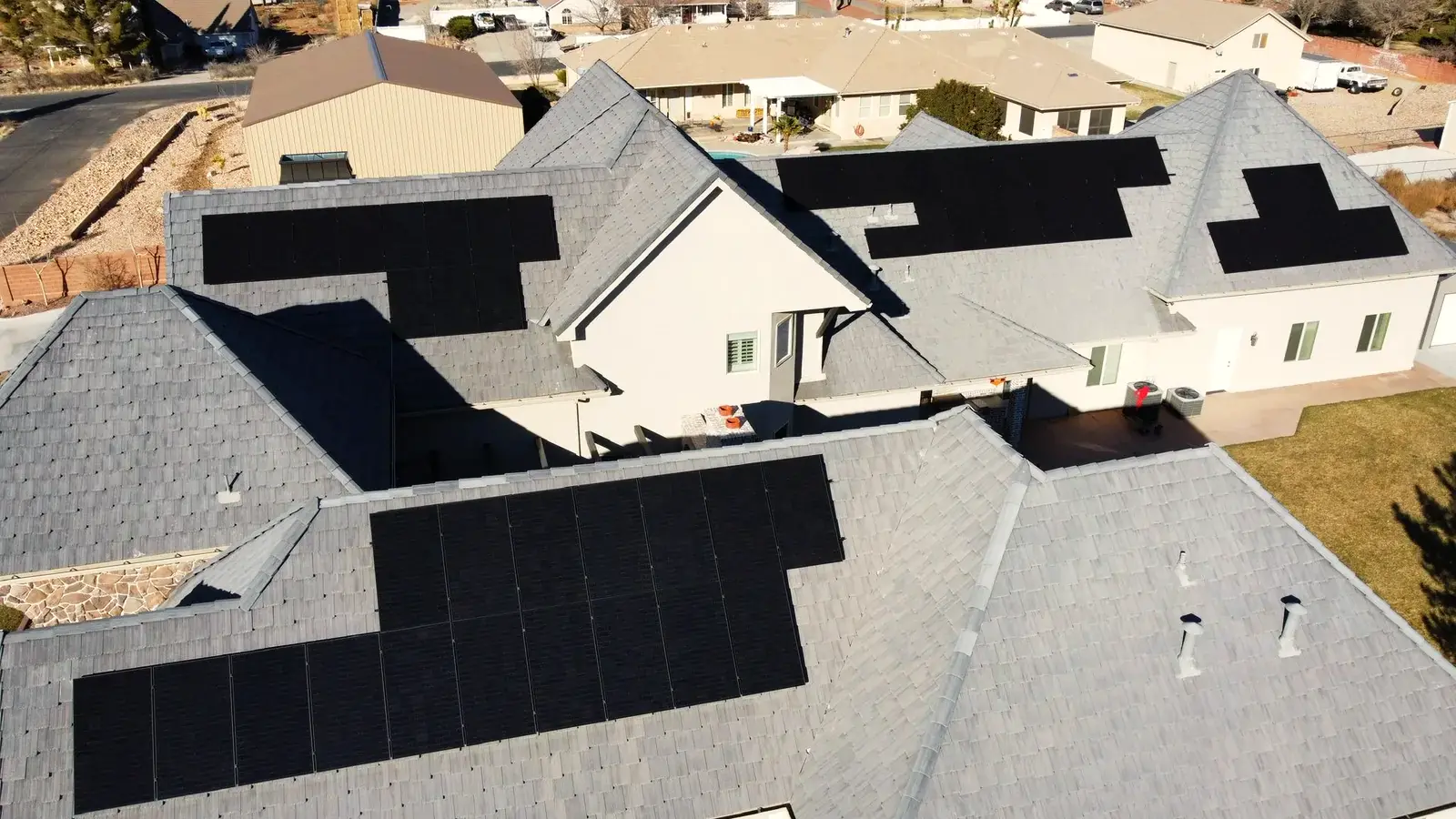
Yes, for a lot of homes. The 30% tax credit homeowners used to claim is gone, and you've probably heard that solar isn't worth it anymore. In Southern Utah, it still pays for many homes, depending mostly on your power company and how much power you use during the day. Power keeps getting more expensive, Southern Utah gets plenty of sun, and the tax-credit savings haven't disappeared. They've just moved.
Here's the case, with the real numbers, and how to check it for your own home.
Power keeps getting more expensive
Utah used to have some of the cheapest power in the country. That's changing. Utah's average residential electricity price rose 15.2% between May 2024 and May 2025, the third-largest jump of any state, according to federal data.
Nationally, the U.S. Energy Information Administration expects the average residential price to rise almost 5% in 2026, to 18.2¢ per kWh. Much of the pressure is growing demand from the commercial sector, which includes data centers. The EIA expects commercial power use to pass residential use for the first time on record in 2027.
Every kilowatt-hour your panels make is one you don't have to buy at tomorrow's price. That's the core of the case for solar, and it gets stronger every time rates go up.
The tax credit savings moved; they didn't disappear
The federal credit homeowners claimed on their own taxes, Section 25D, ended for systems installed after December 31, 2025. That part is true.
But businesses that own solar can still claim a different federal credit for a limited time. Through a prepaid solar plan, a finance company owns your system, claims that credit, and passes part of it to you as a lower upfront price. After the sixth anniversary you have the option to buy the system. We offer this through Maxwell Power. Our post on the solar tax credit in 2026 explains exactly how it works and what to ask before you sign.
For comparison, EnergySage puts the average Utah system at $2.34 per watt installed as of October 2026, about $30,950 for a typical 13.24 kW system, before incentives. Its statewide payback estimate is long, around 22 years, because it uses average Utah rates and usage. Your own utility, how much you use during the day, and a prepaid price can change that a lot, which is why it's worth running your own numbers. For homes that qualify, our prepaid price is typically about 25% below our cash price, and you can finance the prepayment. We show both prices side by side in your proposal.
The biggest factor now: your power company
Solar saves you money in two ways. Every kilowatt-hour your panels make and you use right away is one you don't buy. Every kilowatt-hour you send to the grid earns a credit. How much each one is worth depends on your power company, and in Southern Utah that varies a lot.
Check the name on your power bill, then find it below.
Rocky Mountain Power
Rocky Mountain Power's current program for new solar customers is net billing. Power you send to the grid earns an export credit. Since March 1, 2026, that credit is 4.855¢ per kWh from June through September and 4.033¢ per kWh from October through May.
Power you buy costs much more. Since August 10, 2026, the residential energy charge is 9.83¢ per kWh for the first 400 kWh in summer and 12.53¢ after that, and 8.70¢ and 11.09¢ in winter, before other charges on the bill.
So with Rocky Mountain Power, a kilowatt-hour you use yourself is worth two to three times one you export. Solar pays best when it's sized to cover what your home uses while the sun is up, not more. If you use a lot of power in the evening, that's where a battery starts to make sense. Our post on whether you need a home battery walks through that decision.
Washington City Power
Washington City prices power in tiers, so the more you use in a month, the more each kilowatt-hour costs: 10.2¢ for the first 400 kWh, 11.5¢ for the next 400, 13.8¢ for the next 700, and 17¢ for everything after that. On top of that there's a $20 monthly customer charge and a power cost adjustment.
That tiered structure matters for solar. Big summer air-conditioning bills land in the 13.8¢ and 17¢ tiers, and solar trims those expensive kilowatt-hours first.
Power you send back is credited at 6.5¢ per kWh, and credits don't carry over as kilowatt-hours from month to month. Residential systems are capped at 16 kW AC, and the city caps total customer solar on its system, so ask the city early whether there's room on your line.
St. George City Energy Services
St. George credits extra solar power as kilowatt-hours that stay on your meter and carry forward, so power you send to the grid in spring can offset power you use in summer. That's closer to traditional net metering than the other two.
The trade-off is a Solar Reliability Charge, billed monthly on every kilowatt-hour your system produces, plus the cost of the meters and city reviews. If you have 5,000 kWh or more of credit in December, the city buys it back at its renewable power rate and resets the meter. Ask the city for the current charge before you size a system.
How to run the numbers for your home
You don't need a spreadsheet. You need four things, and a good installer should give you all of them in writing.
- What the system will produce. Your quote should show estimated kilowatt-hours per year for your roof, not just system size.
- How much of that you'll use as it's made. This is the number that matters most for Rocky Mountain Power and Washington City customers. A home that runs the pool pump and AC through the afternoon uses more solar directly than one that's empty all day.
- What each kind of kilowatt-hour is worth. Use your own bill's rates and the credits above.
- The price you'll actually pay, cash or prepaid.
Multiply production you'll use by what you'd have paid for it, add exports times the credit, and you have your first-year savings. Divide the price by that number for a rough payback in years. Rates have been rising, which shortens that payback, but a fair estimate doesn't count on any particular increase. You want a payback well inside the warranties on your equipment, so check those terms in your quote.
Is your home a good fit?
A few things are worth sorting out first:
- Your roof's age. If it needs replacing in the next few years, do that first. Re-roofing under panels means removing and reinstalling them.
- How long you'll stay. Plan on five to seven years or more to get the most out of the system, especially with a prepaid plan, where the option to buy starts after the sixth anniversary.
- Shade and direction. Heavy shade or a mostly north-facing roof cuts production. A ground mount can work instead.
- System size. With Rocky Mountain Power, a system sized to what you use while the sun is up, plus a battery if you use a lot in the evening, usually beats one sized to cover your whole year.
The short version
Solar is still worth it for many homes in St. George. Rates are rising, Southern Utah gets plenty of sun, and a prepaid plan puts tax-credit savings back within reach for 2026 and 2027. The best fits are big daytime users on Washington City or Rocky Mountain Power, and St. George City customers who can bank their summer credits.
If you'd like us to run the numbers for your home, our team does solar design and installation across Southern Utah. We'll show you the cash price and the prepaid price side by side, and we'll tell you honestly if solar isn't the right fit for your home.
Sources
- FAQs for modification of sections 25C, 25D … under the One Big Beautiful Bill Act, IRS fact sheet FS-2025-05, August 21, 2025. Section 25D ends for expenditures after December 31, 2025, counted when installation is completed.
- How does H.R.1 change the residential solar ITC?, Solar Power World, July 2025 (updated July 28, 2025). Deadlines for company-owned systems under Section 48E.
- Utah's power costs spike 15%, Axios Salt Lake City, August 7, 2025, citing U.S. Energy Information Administration data for May 2024 to May 2025.
- EIA: residential electricity prices to rise nearly 5% in 2026, Utility Dive, May 15, 2026, on the EIA Short-Term Energy Outlook of May 12, 2026.
- The cost of solar panels in Utah, EnergySage, updated October 23, 2026. Average cost and statewide payback estimate.
- Maxwell Power, company site, checked October 30, 2026. Prepaid plan terms.
- Zion Electric & Solar, typical prepaid discount for qualifying homes, as of October 2026.
- Approval of Schedule 137 export credit rates, Utah Public Service Commission, February 23, 2026. Rates effective March 1, 2026; Rocky Mountain Power updates them every March 1.
- Rocky Mountain Power tariff filing, Schedule 1 residential service, Docket 26-035-T08, filed August 5, 2026, effective August 10, 2026.
- Washington City master fee schedule for utilities, Washington City, checked October 30, 2026. Residential tiers and the 6.5¢ renewable resource rate.
- Washington City renewable resource policy, Ordinance 2023-23, July 1, 2023. Monthly credits, 16 kW residential cap and citywide cap.
- St. George Energy Services net metering program, City of St. George, revision effective March 8, 2024.